Glass Mounting Systems: Profile, Spider, or Concealed Mounting?

Розташування та інше

Glass Mounting Systems: Profile, Spider, or Concealed Mounting?
Complex of work:

Date done:

A glass structure is 30% glass and 70% engineering. The reliability of a partition or facade depends on how the glass panel is secured in place. Modern technologies allow the fasteners to either become a main accent in a Hi-Tech style or to completely "dissolve" into the interior.

Let's explore three key fastening technologies, their pros, cons, and applications.

1. Profile Systems: Classic and Reliable

This is the most versatile installation method. Glass is inserted into an aluminum or steel profile (clamping or U-shaped), which is attached to the floor, walls, or ceiling.

Features:

  • Sealing: The profile allows for the use of seals, which is important for showers and soundproofed office cabins.
  • Tolerance for Imperfections: The profile can conceal minor wall irregularities (up to 5–10 mm).
  • Zoning: Profiles can be painted in any RAL color, allowing for the creation of popular 'loft-style' partitions with a black outline.

Applications: Office partitions, shower cabins, glass railings on a channel.

2. Spider Systems: Architectural Transparency

Spider (point-fixed) glazing consists of high-strength stainless steel brackets resembling spider legs (hence the name). They connect glass panels to each other and attach them to the supporting structure through holes in the glass.

Advantages:

  • Visual Lightness: The absence of frames creates the effect of a continuous glass surface.
  • Load Resistance: The system flexes with wind or vibrations, making it ideal for external glazing.
  • Scale: Enables the creation of vast glass facades and atriums.

Complexity: Demands perfectly precise design. Even a 1mm misalignment in a glass opening renders the entire panel unusable.

Applications: Shopping mall facades, premium store display windows, glass canopies.

3. Hidden Systems: The Aesthetics of Minimalism

This represents the pinnacle of design. The entire fastening mechanism is 'hidden' within the floor, ceiling, or walls during the rough construction phase. You only see the glass, which appears to 'emerge' from the surfaces.

Advantages:

  • Clean Design: No superfluous details, screws, or profiles.
  • The 'Invisible' Effect: The glass becomes an integral part of the architecture, not just an installed element.
  • Premium Appeal: Most often chosen for elite private residences and luxury offices.

Important: Demands the highest skill from builders, as the chases for the fixings must be perfectly level.

Applications: Glass terrace railings, interior partitions, doors with concealed frames.
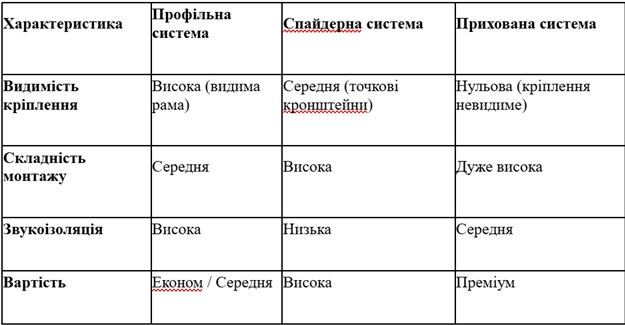
System Comparison Table

How to make the right choice?

When selecting a mounting system, we recommend considering three factors:

  1. Glass type: For spider fittings, only tempered glass (triplex) is used, as high stress occurs at the holes.
  2. Load: A reinforced bottom profile is better suited for high railings in public areas.
  3. Budget: Profile systems are the most reliable budget option, while hidden systems require significant costs for room preparation.

Expert Opinion

Choosing a mounting system is the job of a structural engineer, not just a designer. Every bolt and profile must comply with DBN (State Building Codes) regarding loads. The profile ensures stability, the spider provides transparency, and hidden installation offers impeccable style.

HAVE A CONCEPT OR A READY DESIGN?

Send us an inquiry or reach out directly.
Submit Inquiry
By clicking 'Submit', you agree to our Privacy Policy
Thank you! Your application has been received!
Oh! Something went wrong while sending the form.

ALSO READ

All states
02.06.2022
Glass canopy in a private house, United Kingdom
Glass canopy with vertical support by triplexed glass, with a warm exhaust system and windows.
Read more
2020-2021
Glass fences in the shopping center “Respublika”
Read more
2021
Glass partitions of BC “Toronto”
Read more